
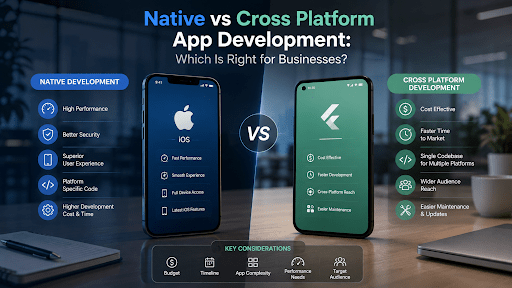
At some point, almost every business building a mobile app hits the same wall: should this be built natively for iOS and Android separately, or built once using a cross-platform framework? It sounds like a simple technical decision, but it actually shapes the budget, timeline, user experience, and how easily the app can grow later. Get it wrong, and a business can end up rebuilding from scratch a year in which is exactly why choosing the right Cross Platform App Development Company for this decision matters as much as the decision itself.
This isn’t a question with one correct answer for every business. It depends on what the app needs to do, who it needs to reach, and how much the business is willing to invest upfront versus over time. Let’s break down what actually separates these two approaches, without the marketing spin either side tends to attach to itself.
What Native Development Actually Means
Native development means building a separate app for each platform, using the language and tools that platform is designed around Swift or Objective-C for iOS, Kotlin or Java for Android. Each version is built independently, specifically for its own operating system.
Because native apps are built directly for their platform, they tend to run faster, feel smoother, and integrate more seamlessly with device-specific features like cameras, GPS, biometric sensors, and push notifications. Users often can’t articulate why a native app feels better, but they usually notice it.
What Cross-Platform Development Actually Means
Cross-platform development flips the approach. Instead of writing separate code for iOS and Android, developers write one codebase that works across both platforms, using frameworks designed to translate that single codebase into apps that run natively on each system.
This approach has matured significantly over the past several years. What used to mean noticeably clunky, slower apps now often produces results that are hard to distinguish from native builds, especially for apps that aren’t pushing the outer limits of device performance.
Comparing the Two: What Actually Matters for a Business
Development Cost
This is usually where the conversation starts, and for good reason. Native development means building and maintaining two separate codebases, which typically means two separate development tracks, sometimes two separate teams. Cross-platform development consolidates that into a single codebase, which generally cuts development costs significantly often the single biggest factor pushing businesses toward this route.
Time to Market
Speed matters, especially for businesses trying to launch before a competitor or capture a specific market moment. Cross-platform development is usually faster simply because there’s one codebase to build, test, and refine instead of two running in parallel. For businesses racing against a deadline, this speed advantage can be decisive.
Performance
Native still holds a real edge for performance-intensive apps think heavy gaming, advanced augmented reality, or apps leaning hard on complex device hardware. For most standard business apps, though booking platforms, e-commerce, service apps, internal tools the performance gap has narrowed enough that most users won’t notice a difference.
User Experience and Platform Feel
Native apps naturally follow each platform’s own design language, which can make them feel more familiar to users on that specific device. Cross-platform apps have closed much of this gap, but achieving a truly native feel still requires skilled developers who know how to work around the framework’s limitations rather than accepting its defaults.
Access to Device Features
Apps that lean heavily on cutting-edge or platform-specific hardware features sometimes hit friction with cross-platform frameworks, since new OS features often reach native development tools before they’re supported cross-platform. For most everyday business apps, this gap rarely causes real problems.
Long-Term Maintenance
Maintaining two native codebases means double the ongoing work every time a feature gets added or a bug gets fixed. Cross-platform development simplifies this considerably, since most updates only need to happen once and then apply across both platforms.
Popular Frameworks Businesses Are Actually Using
Cross-platform development isn’t a single tool, it’s a category with several strong options, each with its own strengths. Businesses evaluating their options for the Top 5 Cross-Platform Frameworks for Mobile App Development typically land on Flutter, React Native, Xamarin, Ionic, and NativeScript, each offering different trade-offs around performance, community support, and how closely the final app resembles a fully native build. The right choice usually comes down to the specific technical requirements of the app and the existing skill set of the development team involved.
So Which One Is Actually Right for Your Business?
There’s no universal answer, but a few patterns tend to hold up consistently.
Choose native if:
- The app relies heavily on advanced device features or high-performance graphics
- User experience needs to feel flawless and platform-specific down to the smallest detail
- Budget and timeline allow for building and maintaining two separate codebases
- The app is central to the business and expected to scale significantly over time
Choose cross-platform if:
- Speed to market and budget are major constraints
- The app’s core functionality doesn’t depend on cutting-edge hardware features
- The business wants a single team maintaining one codebase going forward
- The goal is testing an idea or launching an MVP before committing to a bigger native build
Many businesses actually start cross-platform to validate an idea quickly and affordably, then transition to native later once the app has proven its value and justified a larger investment. There’s no shame in that path, it’s often the smarter one financially.
The Decision Isn’t Just Technical
Beyond the technical comparison, this decision really comes down to business priorities. A startup testing a new concept has very different needs than an established enterprise building a flagship customer app. Budget constraints, target audience, expected app complexity, and long-term product vision all factor into which approach actually makes sense.
This is also why the development partner chosen for this project matters so much. A team that only works in one approach will naturally lean toward recommending it, regardless of whether it’s genuinely the best fit. The right partner evaluates the business’s actual needs first and recommends an approach based on that, not on which tools they happen to be most comfortable using.
Final Thoughts
Neither native nor cross-platform development is universally “better.” Each solves different problems well, and the right choice depends entirely on what a specific business is trying to build, how fast they need to move, and what they’re willing to invest now versus later. Businesses that take the time to honestly assess their priorities before choosing a path tend to end up with apps that actually serve their goals instead of apps built around a decision that never quite fit the business in the first place.
