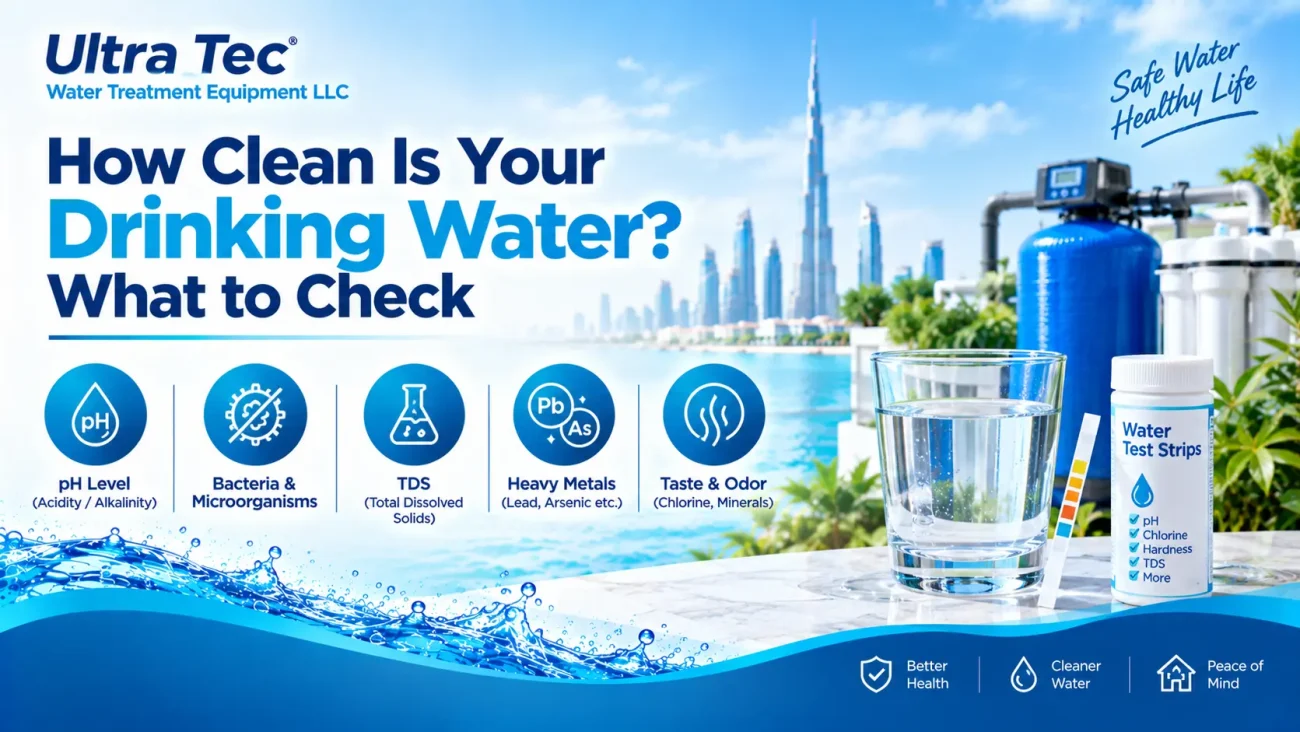
You pour a glass from the tap or the bottle without a second thought. But how do you actually know if your drinking water is clean? Taste and clarity help, but they only tell part of the story. This guide explains what to check, the common warning signs, and when it makes sense to seek help.
Start With Your Water Source
Where your water comes from determines what it could contain. Most homes in the UAE receive treated municipal water, while some villas, farms, and older buildings use borewell or tanker water. Treated supply is processed before it reaches your building, but the last stretch matters too. Water passes through storage tanks and internal pipes, which can change its quality at the tap. If you want a closer look at this, read about Dubai tap water quality.
Borewell and tanker water carry different risks, such as high salts, hardness, sediment, or iron, so they usually need testing before anyone decides on treatment.
Check With Your Senses First
Your senses will not catch everything, but they are a quick first check. Look for:
- Taste: a salty, metallic, bitter or flat taste
- Smell: a strong chlorine, musty or rotten-egg smell
- Colour and clarity: cloudy, yellow or brown water
- Particles: sand, rust flakes or sediment at the bottom of a glass
- Scale: white deposits on taps, kettles and shower glass, a sign of hard water
Many of these are explained in our guide to common home water quality problems and their solutions.
Check Your Building’s Tank and Pipes
In apartments and villas, water often sits in a rooftop or underground tank before reaching your tap. If a tank is not cleaned regularly, sediment and biofilm can build up, and old pipes can add metal or rust. A good habit is to ask your building management how often the tank is cleaned, and to flush taps that have not been used for a few days.
Measure TDS for a Quick Reading
TDS stands for total dissolved solids. It measures the dissolved minerals and salts in water, usually in ppm. A handheld digital TDS meter gives you a reading in seconds, which makes it a handy way to compare tap water, filtered water, and bottled water.
One important point: TDS is not a safety test. A low number does not prove the water is safe, and a higher number does not always mean it is harmful. TDS does not detect bacteria, specific chemicals, or heavy metals. Use it as a screening tool, not a final answer.
Get a Proper Water Test When Needed
A lab-based water analysis gives you real numbers for the things you cannot see or taste. It is worth doing when:
- You use borewell, well or tanker water
- Your water has an unusual taste, smell or colour
- You see heavy scale or staining
- Someone in the home has sensitive health needs, such as infants or people with weakened immunity
- You are choosing a treatment system and want to avoid guessing
A test also protects your budget. Without one, it is easy to buy a system that treats the wrong problem.
Match the Problem to the Right Solution
Different problems need different treatment. Buying the biggest purifier is not the answer.
| What you notice | What may help |
| Chlorine taste or odour | Activated carbon filtration |
| Sand, silt or rust | Sediment filtration, or a whole-house filter |
| High TDS or salty taste in drinking water | Reverse osmosis |
| Microbial concerns | UV sterilization, selected after assessment |
| White scale and hard water | A water softener |
Many homes need more than one stage. For example, a villa on tank water may use whole-house filtration for sediment and chlorine, and a separate drinking-water purifier in the kitchen.
Do Not Forget Filter Maintenance
A filter only protects your water while it is working. Old cartridges lose effectiveness, and neglected filters can even become a place where bacteria grow. Signs that a filter needs changing include a drop in flow, a return of taste or smell, or simply passing the manufacturer’s replacement date. Keep a note of when you installed each cartridge, and check that replacement cartridges and filters are easy to get locally before you buy a system.
How to Choose a Supplier You Can Trust
Once you know what you need, the next step is choosing who to buy from. A good supplier should ask about your water source, explain what each filter stage does, include installation, and offer after-sales support. If you are comparing options, our guide to water purifier suppliers in the UAE explains what to look for. For bigger projects, you can also read how to evaluate the top water treatment companies in the UAE.
A Simple Checklist
- Know your water source (municipal, borewell, or tanker)
- Notice taste, smell, colour, and scale
- Ask how often your building cleans its tank
- Check TDS as a quick reading, not a safety test
- Get a lab test if you use borewell water or have concerns
- Choose treatment based on test results, not stage count
- Replace filters on schedule
Final Thoughts
Clean drinking water is not something you can judge by looking at it. A few simple checks, a water test when needed, and the right treatment for the actual problem go a long way. If you would like help understanding your water, Ultratec Water Treatment can review your water source and recommend a suitable solution.
