
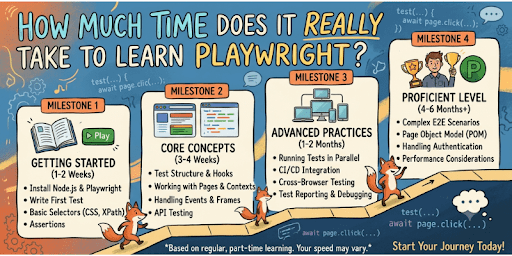
When learning a new automation tool, it can be hard to get started, particularly in terms of the time it will save you. Playwright is gaining traction for use in modern web application testing, which is suitable for multiple browsers and offers capabilities for reliable end-to-end automation. It’s something that can be learned within a few days of programming experience, several years of testing, and consistent practice.
The time varies depending on the specific condition being treated.
If you already know the basics of programming and basic software testing, the basics of Playwright can be learned within a few weeks. Some beginners may require more time to get familiar with programming concepts, selectors, assertions and test structures.
The following is a very simple learning progression:
- 1-2 weeks: Introduction to Playwright concepts and installation.
- 3-4 weeks: Developer of basic automated tests; use of locators.
- Advanced testing features and debugging practices are continued.
- At 2–3 months, create more complex projects and feel more comfortable with actual test scenarios.
The times do not have to be set in stone. Typically, the number of days spent in practice, rather than study, is more important.
First, Learn the Basics
It’s useful to get a handle on how Playwright works before going into more advanced automation. The first steps are learning how to launch the browser, navigate pages, use a locator, assertion, screenshot and execute the test for a beginner.
They are very simple to understand when you come across Playwright Examples and see their applications when they are used in real scenarios of testing. Rather than focusing only on the syntax, you can try changing the conditions and see the results of the test, which will give a more practical learning experience. Playwright Training in Gurgaon is one such platform where you can learn more if needed.
For Python learners, Playwright also provides Python automation. If you have some experience in Python programming, and you want to integrate it with your browser testing, then you may find it useful to have some exposure to playwright python.
Practice is the key to success.The more you practice, the better you will get.
You may read the documentation and get the groundwork, but it is the hands-on that will help you build your confidence. With small projects you can come across typical testing issues and learn to solve them.
Such as, you can exercise:
- Applying a new design to existing login and registration pages
- Performing calculations and formatting
- Multitabbing.Multitabbing.
- Managing waits and dynamic elements.Handling waits and dynamic elements.
- Using the phone tree and becoming an active participant.* Making sure to take screenshots in failures
- Testing on different machines and operating systems.* Using multiple browsers and machine/OS combinations.
For this reason, serious individuals who want to develop their automation abilities may invest extra time to complete the practical exercises in a structured manner. If you’re interested in finding more structured learning experiences in your area, there is a Playwright Training in Chennai available.
Move Towards Advanced Concepts
After the fundamentals, it is time to learn features that can be used in more complex automation tasks. This includes fixtures, test hooks, reusable functions, reporting, debugging and parallel execution of tests.
It is also helpful to know a full test workflow with Playwright. It can be more useful to understand how tests are maintained, organised, executed and analysed, rather than to know specific test commands.
It may be beneficial for learners to work on creating a small automation “architecture” at this point, instead of having to write many individual scripts. Realistic scenarios can be useful to uncover missing information and help to make complex ideas more concrete.
What is This: How Can You Learn Faster?
There is no one easy way, but there are steps to make the process easier. Taking the time daily to write and refine tests will help to establish familiarity over time.
A practical way to do this is to:
- Do one thing at a time.
- Quickly write a small test.
- When things go “out of the way”, try an experiment.
- Review the test code, and improve it.
- Gradually work on larger scenarios.
While simultaneously developing personal automation projects, one can check out Playwright Training in Bangalore for extra opportunities to practice.
The speed of the machine is not as important as the experience of the person operating it.
Aiming to complete Playwright as quickly as possible isn’t necessarily best. Why a test fails, how to select reliable locate and writing maintainable automation scripts are skills that you learn with practice.
As your app grows more complex, you could run into issues with authentication, dynamic content, flaky tests, API interactions, and browser compatibility. These scenarios are obviously great opportunities to build muscle memory.
If you want to further develop your automation skills then you can try out the Playwright Training in Hyderabad as well along with the assignment and project work.
So then the question is, how much time does it take to get to know Playwright? The beginner can grasp the basics in a matter of weeks and be truly comfortable with advanced automation can take months. The time is dependent on your programming experience, testing experience, practice routine and project exposure.
What matters is not getting it done, but developing valuable automation skills. As you continue to learn, you can delve deeper into subjects like Playwright Training that can be part of a larger educational experience. Over time, Playwright becomes easier to work with with regular practice and real project experiences.
